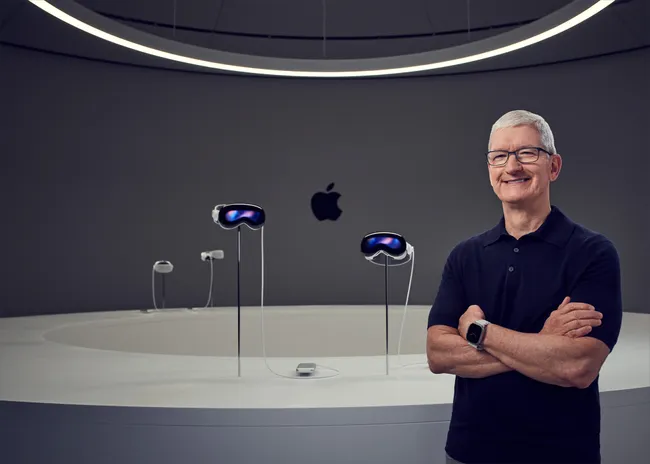
2025 has not been kind to Apple. From the underwhelming reception of its much-hyped Apple Vision Pro to mounting internal challenges with artificial intelligence, the tech giant has found itself in unfamiliar territory—on the back foot.
April has arguably been the most turbulent month so far. President Donald Trump’s announcement of sweeping tariffs on a range of countries rattled markets and sent Apple’s stock sliding. The company reportedly lost over $700 million in market value in a single day, according to Investopedia.
But there was some relief late Friday, as the administration confirmed that smartphones, laptops, and computers would be exempt from the tariff list. The move offered a temporary reprieve for Apple, whose global supply chain—particularly its reliance on manufacturing in China—remains vulnerable to trade policy shocks.
AI: The Weak Link
Beyond geopolitics, Apple is also grappling with internal friction over its AI strategy. A New York Times report published Friday exposed a series of delays, resource battles, and leadership shake-ups that have slowed the company’s progress in the AI race.
Apple’s AI issues reportedly trace back to 2023, when John Giannandrea, then head of AI, requested a substantial boost in GPU resources to power Apple’s next-gen artificial intelligence tools. The company had around 50,000 GPUs in its data centers—many already outdated.
While CEO Tim Cook initially approved a doubling of the chip budget, Apple CFO Luca Maestri slashed that budget by more than half, creating major bottlenecks. To make matters worse, the chips acquired weren’t from Nvidia—the undisputed leader in AI hardware—but from Google, raising eyebrows in the industry.
Although an Apple spokeswoman later clarified that Giannandrea’s request was eventually fulfilled, the damage may have already been done. The delays stunted Apple’s ability to deliver competitive AI features, just as rivals like Microsoft, Google, and OpenAI surged ahead.
Siri Stumbles and a Changing of the Guard
Apple’s marquee AI initiative was a long-anticipated overhaul of Siri, transforming it from a basic voice assistant into a fully capable AI-driven tool. The upgraded Siri was originally slated for a spring release alongside the iPhone 16, but the launch was abruptly canceled last month.
The failure triggered a leadership reshuffle. Giannandrea was removed from his role, and Mike Rockwell—best known for spearheading development of the Vision Pro—stepped in to lead the Siri and broader AI team. According to the Times report, the next-gen Siri is now expected to debut in the fall, likely tied to the launch of the iPhone 17.
WWDC 2025: A Crucial Moment
The next key milestone for Apple comes on June 9 at its annual Worldwide Developers Conference (WWDC). There, the company will unveil iOS 19, macOS updates, and WatchOS enhancements. It’s also expected to showcase more of what it’s calling Apple Intelligence—its long-awaited leap into the AI era.
For Apple, WWDC won’t just be a stage to introduce new software—it will be a litmus test of whether the company can reassert itself as a pioneer in a fast-evolving tech landscape. With mounting pressure from shareholders and fierce competition in AI, Apple needs a big win.



Leave a Reply