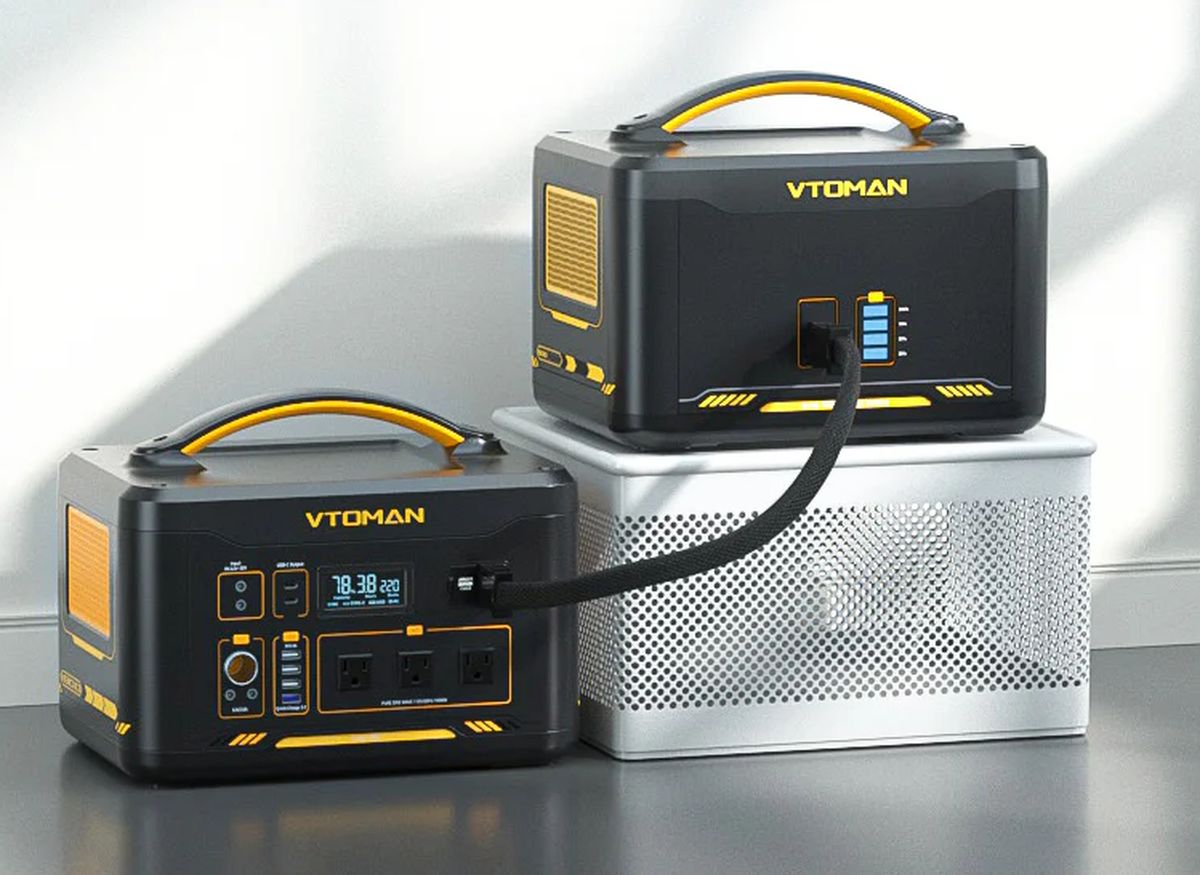
In an era where reliable power on-the-go is increasingly essential — whether for camping, overlanding, or emergency preparedness — the VTOMAN Jump 1800 positions itself as a powerful all-in-one solution. With a generous battery capacity, solar charging, and even a built-in vehicle jump starter, this power station aims to replace both gas generators and smaller portable battery packs. After weeks of hands-on testing, here’s how it stacks up.
A Serious Power Upgrade for Serious Use Cases
Unlike compact portable units designed for smartphones or small appliances, the VTOMAN Jump 1800 is a beast. It packs a 1548Wh LiFePO4 battery, expandable to 3096Wh with the companion Jump 1500 Extra Battery. Its inverter delivers a continuous 1800W output (peaking at 3600W), enough to power space heaters, small fridges, or power tools with ease.
At nearly 42 pounds per unit, it’s not light — but then again, neither are the use cases it targets: extended off-grid adventures, job sites, or backup power for outages. The inclusion of passthrough charging makes it particularly effective as a mini off-grid power hub, allowing devices to run while the battery charges from solar or AC power.
What You Get for the Price
The full package includes:
- The Jump 1800 power station
- 1548Wh Jump 1500 Extra Battery
- A 200W foldable solar panel
- A set of jumper cables
- Assorted charging cables, adapters, and a storage case
Currently listed at $2,947.00, the bundle is discounted to $1,339.99 or $2,199.99 depending on configuration. VTOMAN offers an additional $30 off with the code VTUSJP18BD3 until May 31, 2025.
Design and Build: Rugged and Practical
Shipping in heavy-duty packaging from China, the units are well protected with dense foam inserts. Both the main and auxiliary battery packs feature solid, bolted handles for easier handling. However, stacking the units is awkward due to uneven surfaces. The foam inserts can be repurposed as stabilizers — a makeshift but effective solution.
The units connect via a 30-inch umbilical cable. While snug and secure, this cable can get hot during use and should be handled with care. It also limits how far apart the units can be placed, a potential issue in tight setups.
Solar Panel Performance
The included 200W monocrystalline solar panel boasts a 23% efficiency rate, impressive on paper and respectable in practice. On a clear day with partial shading, the panel produced 185W — strong performance considering conditions. However, the panel lacks built-in alignment tools, which makes optimal angling a trial-and-error affair.
With an IP67 water resistance rating, the panel can handle splashes but not prolonged exposure to rain or submersion.
Charging, Operation, and Performance
The VTOMAN system supports three charging modes: wall (328W), car, and solar. However, it only features a single internal charging circuit. As a result, input from multiple sources doesn’t stack — plugging in both wall and solar power won’t exceed the higher of the two input wattages.
Charging the main unit to 100% takes around five hours via AC, with the auxiliary battery charging only after the main unit is full. Interestingly, the system prioritizes keeping the main battery at full capacity, a strategy that makes sense in emergencies but could accelerate long-term battery degradation. There’s currently no option to change charging priority — a missed opportunity.
Another standout feature is passthrough charging. During one test, the system powered a 1300W heater while drawing 220W from solar. The balance came from the battery itself, with the display estimating runtime and input/output wattages in real-time.
The onboard display is accurate and informative, though not remotely accessible. Bluetooth or app support would enhance the unit’s usability in remote or awkwardly placed setups.
Shortcomings in Design
A few ergonomic and usability issues are worth noting:
- The jumper cable attachment is too short, limiting its effectiveness unless the entire 42 lb unit is lifted into position near a vehicle battery.
- AC output is limited to 15 amps — adequate, but short of the 20A found in competitors like the EcoFlow Delta 3.
- Loud cooling fans (measured at 80 dB) kick in as needed, which could be disruptive in quiet environments.
- The built-in light faces away from the outlets — counterintuitive if you’re working in the dark.
- The included cables are sufficient, but one adapter (MC4 to DC7909) could be longer, and a DC5521-to-DC7909 adapter would have improved compatibility.
A Note on Safety
The unit uses high-voltage LiFePO4 batteries, which are significantly safer and more thermally stable than typical Li-ion or LiPo cells. That said, standard lithium safety practices apply: don’t leave it unattended while charging, and avoid enclosing it in flammable or poorly ventilated areas.
Final Verdict: A Serious Tool for Power Users
The VTOMAN Jump 1800 is not a casual consumer gadget — it’s a rugged, high-capacity energy solution built for serious applications. While it isn’t without quirks, its combination of expandability, solar integration, and passthrough functionality gives it strong value at its discounted price.
For those seeking reliable power far from the grid, or who want a battery backup that goes beyond USB devices, the VTOMAN Jump 1800 is a compelling, if hefty, option.
Pros
- High-capacity, expandable power
- Safe, long-lasting LiFePO4 battery chemistry
- Useful passthrough charging
- Capable of jump-starting vehicles
- Solar-ready and efficient
Cons
- Heavy and bulky
- No remote monitoring or app integration
- Loud fans
- Limited cable and adapter lengths
Where to Buy
- VTOMAN: $2,199.99 (or $1,339.99 without extras). Use code VTUSJP18BD3 for $30 off (valid until May 31, 2025)
- Amazon: Pricing may vary by configuration
Would you like this formatted for a specific publication, blog platform, or style (e.g., Forbes, Wired, Medium)?



Leave a Reply