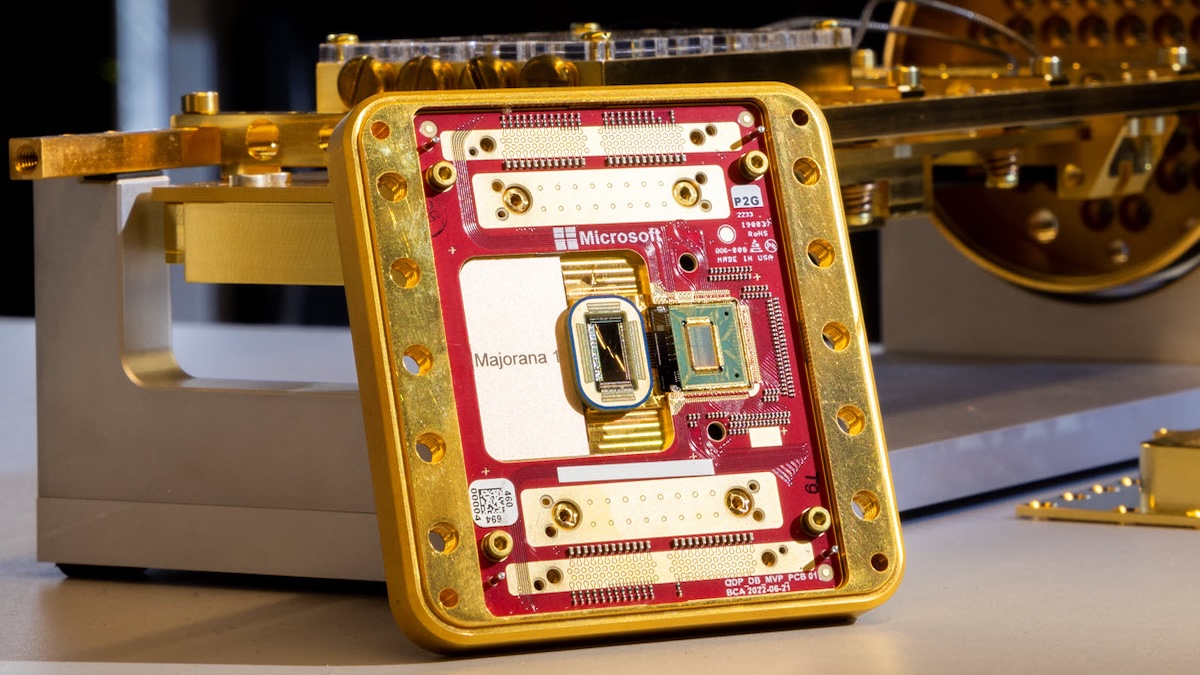
Microsoft has unveiled the Majorana 1, the world’s first quantum processing unit (QPU) using topological qubits, claiming it can scale up to a million qubits on a single chip. While this is an impressive technical achievement, the key question remains: does it accelerate the timeline for practical quantum computing—especially cryptanalytically relevant quantum computers (CRQC) that could break current encryption standards?
Why Quantum Computing Matters
Quantum computing has the potential to revolutionize industries, enabling breakthroughs in:
✅ Drug discovery (modeling complex molecules)
✅ Agriculture (optimizing crop growth)
✅ Material science (designing new materials)
✅ Artificial Intelligence (enhancing machine learning capabilities)
However, before its benefits are fully realized, quantum computing also presents a major cybersecurity threat: it will be capable of breaking today’s encryption, which secures everything from financial transactions to national security data.
The Unique Value of Topological Qubits
Most existing quantum computers rely on superconducting qubits (like those from IBM and Google) or trapped ion qubits (like those from IonQ). However, these qubits suffer from high error rates due to their extreme sensitivity to environmental noise—a problem called decoherence.
Topological qubits, like those used in Microsoft’s Majorana 1, aim to overcome these limitations by encoding information in a system’s topology rather than in individual quantum states. This makes them:
✔️ More stable (less prone to errors)
✔️ More scalable (fewer qubits needed for error correction)
✔️ More efficient (potentially leading to faster quantum computers)
How Majorana 1 Works
The Majorana 1 uses a breakthrough material called a “topoconductor”, which combines:
- Indium arsenide (a semiconductor)
- Aluminum (a superconductor)
By cooling this material close to absolute zero and applying magnetic fields, Microsoft was able to create Majorana Zero Modes (MZMs)—exotic quantum states that enable topological qubits.
Does This Breakthrough Accelerate the Quantum Timeline?
Experts agree that Majorana 1 is a major milestone, but whether it shortens the path to practical quantum computing remains uncertain.
💬 Scott Aaronson (Quantum Computing Expert):
“If Microsoft’s claim stands, then topological qubits have finally reached the level of traditional qubits from 20-30 years ago.”
💬 Duncan Jones (Head of Cybersecurity at Quantinuum):
“Progress across all modalities is so rapid right now that the timeline to CRQCs could shrink further.”
💬 Rebecca Krauthamer (CEO, QuSecure):
“Microsoft is talking about commercial quantum machines within five years. A scalable qubit design like this could be the stepping stone.”
⏳ Realistic Timeline Estimates:
- 5–10 years: A fault-tolerant quantum prototype
- 7+ years: A CRQC capable of breaking current encryption
- 10+ years: Large-scale commercial quantum computers
Cybersecurity & The Post-Quantum Challenge
The biggest immediate concern is that a sufficiently powerful quantum computer (CRQC) could break today’s encryption, particularly public-key encryption (PKE) used for securing data.
🔴 If CRQCs arrive sooner than expected, organizations that delay migration to post-quantum cryptography (PQC) will be vulnerable.
💬 Phil Venables (Google Cloud CISO):
“Even though 7–10 years sounds far away, the complexity of migration means organizations might already be too late.”
💬 Marc Manzano (SandboxAQ):
“The window for migration is shrinking, and a reactive approach is not an option.”
What Needs to Be Done Now?
✅ Start transitioning to PQC algorithms (e.g., NIST’s post-quantum cryptography standards)
✅ Inventory cryptographic assets (understand what data is at risk)
✅ Adopt crypto agility (ability to switch encryption methods when needed)
✅ Monitor quantum developments closely
Conclusion: A Game-Changer, But Not an Immediate Threat
Microsoft’s Majorana 1 is a groundbreaking step toward scalable quantum computing, but it doesn’t guarantee an immediate quantum leap. It still faces major hurdles, including:
- Proving stability and reliability at scale
- Developing robust error correction methods
- Building the infrastructure for commercial adoption
However, the momentum behind quantum computing is accelerating. Whether it’s 5 years or 10 years, the arrival of quantum decryption is a matter of when, not if. Organizations must act now to secure their data for the post-quantum era. 🚀🔐



Leave a Reply